
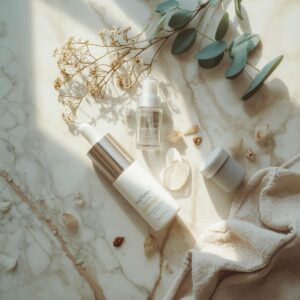
Clean beauty is one of those terms that gets thrown around constantly — but rarely explained clearly.
Walk into any beauty aisle and you’ll see the word “clean” on everything from face wash to foundation. It’s become one of those words that sounds meaningful but gets used so loosely that it starts to mean nothing at all.
So let’s cut through it.
Clean beauty, in plain terms
Clean beauty is about formulating products without ingredients that are known — or strongly suspected — to be harmful to human health or the environment. Think synthetic fragrances, parabens, sulphates, certain preservatives, and chemicals that linger in the body or wash into waterways.
It’s not necessarily the same as “natural” (which has its own complicated meaning), and it’s not always “organic” either. A product can be clean and use lab-created ingredients — what matters is that those ingredients are safe, traceable, and chosen with intention.
Clean beauty is, at its core, a transparency movement. It asks brands to be honest about what’s in their products and why — and it asks consumers to start reading labels.
Why clean beauty connects to the environment
Your skincare routine doesn’t stay on your skin. When you rinse off a cleanser or step out of the shower, everything goes somewhere. Certain synthetic chemicals — UV filters, microplastics, synthetic musks — have been found in rivers, marine life, and drinking water sources.
Choosing clean beauty products isn’t just a personal health choice. It’s a decision that ripples outward — into waterways, ecosystems, and the bodies of people downstream.
The ingredients worth knowing
You don’t need to memorise a chemistry textbook, but a few names are worth recognising when you’re building a clean beauty routine.
Oxybenzone, commonly found in sunscreens, has been linked to coral reef damage. Microbeads — now banned in the UK — were once widely used in face scrubs and toothpaste, entering water systems in their billions. Synthetic fragrances can contain dozens of undisclosed chemicals under a single word on an ingredient label.
Parabens, used as preservatives, are endocrine disruptors that have been found in human tissue. Sulphates, while effective cleansers, strip the skin’s natural barrier and are often unnecessarily harsh.
None of this means every product on the shelf is dangerous. But it does mean that knowing what’s in your products — and what isn’t — puts you in a stronger position.
It doesn’t have to be expensive
One of the most persistent myths about clean beauty is that it costs more. Sometimes it does. But increasingly, accessible brands are formulating without the problematic ingredients, at ordinary price points.
And when you start to simplify your clean beauty routine — using fewer products, choosing multitaskers, finishing what you have before buying something new — the overall cost often evens out, or even drops.
The sweet spot is finding products that work, that you trust, and that don’t require you to cross your fingers about what’s inside.
Where to start
If clean beauty feels overwhelming, begin with the products that stay on your skin the longest — moisturisers, serums, and SPF. These have the most direct and sustained contact with your skin, and therefore the most potential for absorption.
From there, work through your routine gradually. There’s no need to throw everything out and start over. Use what you have, and make cleaner choices as products run out.
Clean beauty isn’t about being perfect. It’s about making more informed choices, one product at a time.